

Checkout can fail before the frontend shows why
When a Magento checkout becomes unstable, the symptoms are easy to see but often hard to explain.
A discount appears once and disappears later. A shipping selection changes the total unexpectedly. The cart looks correct, but the submitted order does not match what the customer saw. A defect passes QA several times and then appears in production.
Start by checking JavaScript, cache, sessions, payment components, and infrastructure. Those areas may be part of the problem.
When checkout state seems to change on its own, ask one direct question:
What custom code is changing the quote, and from where?
A quote-mutating observer is one of the first places to look.
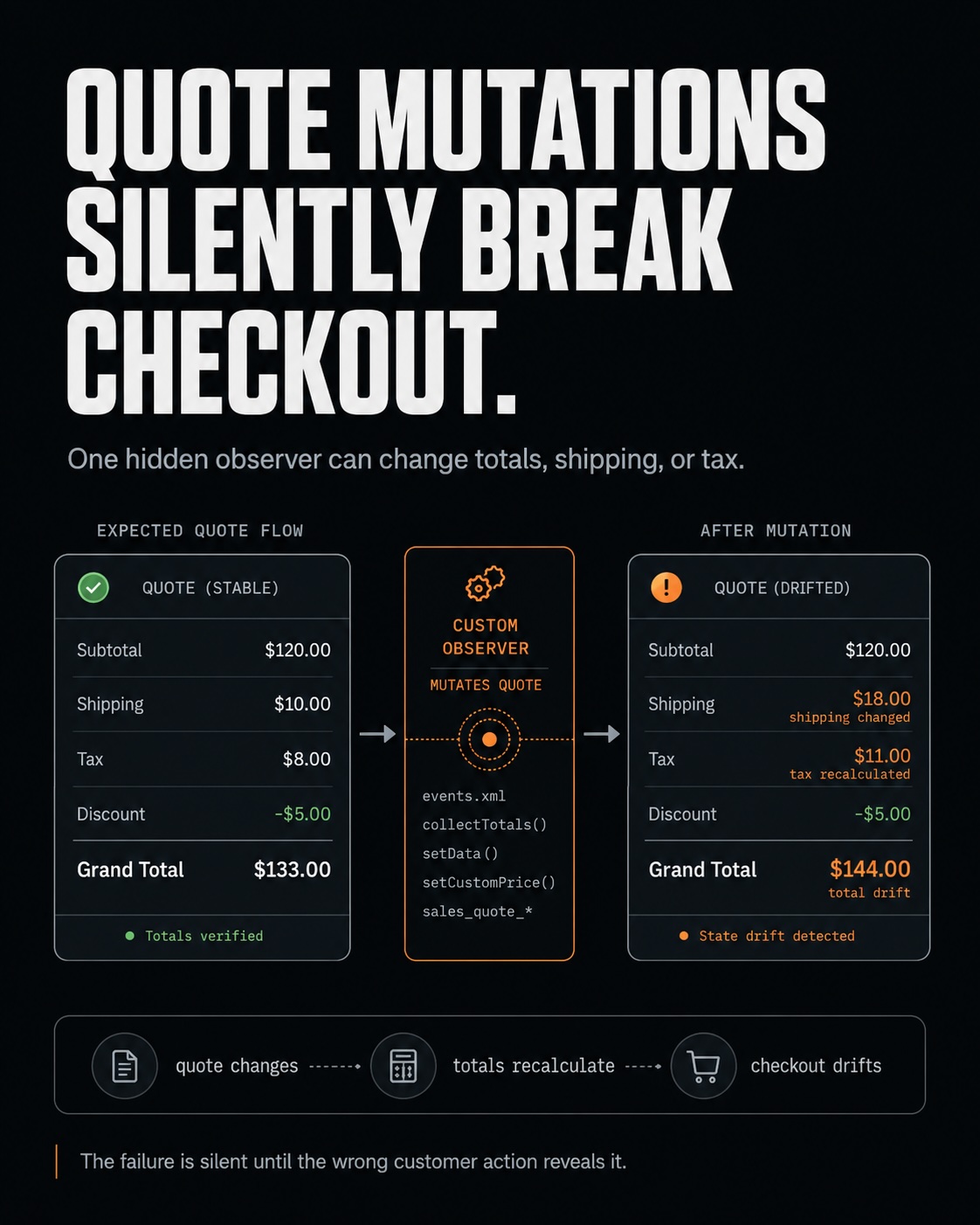
Why developers use observers
Magento events make it easy to react when something important happens. A developer can listen for quote, cart, checkout, address, or save-related activity and add custom behavior without editing core code.
That flexibility is useful, but it needs clear limits.
It also makes observers tempting places to hide business decisions:
- apply a custom discount
- change a quote item value
- add or remove a fee
- set quote flags
- adjust shipping-related state
- call an external service
- persist calculated data
- enforce a checkout rule indirectly
In a basic test, the code may appear successful. Add a product, enter a coupon, select shipping, see the expected total, and approve the work.
The risk begins when the observer changes shared checkout state during a lifecycle that can run related logic again. The second run may happen in a different order or use state that another action already changed.
This is how a clean-looking customization becomes an intermittent production defect.
Adobe's observer guidance points to the risk
Adobe Commerce and Magento Open Source observers react to dispatched events. Adobe's developer guidance gives several rules that apply directly to checkout stability:
- observers can influence application behavior, performance, and business logic
- observers listening to frequently dispatched events should remain small and efficient
- complex computations inside frequently dispatched observers can slow application processes
- observers should avoid cyclical event loops
- observers should not assume a reliable invocation order or depend on another observer executing first
These rules apply to every observer.
They are especially important in checkout. A change in quote state can affect the amount the customer pays, whether a promotion applies, which shipping options appear, and whether the order can be placed.
Observers can be a valid Magento extension point.
A hidden, stateful checkout decision inside an observer is where the risk begins.
The quote is shared checkout state
The Magento quote represents the working cart and checkout state before an order is finalized. It contains information that other platform behavior depends on: items, quantities, addresses, shipping selections, discounts, totals, customer context, and checkout-related values.
When custom code modifies that state, other checkout code can see the change.
A later checkout action may read the modified value as though it were original input. Another calculation may execute against it. A promotion rule may evaluate after the custom change. An order-conversion path may see a quote that no longer represents the same assumptions used earlier in the customer journey.
That is the critical distinction:
Calculating from quote state is one thing.
Changing quote state from an observer, while other checkout behavior depends on that same state, is another.
Repeated execution is only part of the risk. The result can become unsafe when the checkout lifecycle evaluates the changed quote again.
How quote-mutating observers fail in production
A quote mutation problem rarely arrives with a log entry saying the observer is wrong. It arrives through symptoms.
Discounts applied twice or lost later
A custom adjustment appears correct in one cart state, then compounds or disappears after another checkout action recalculates the customer's order.
Totals that change after shipping selection
An address or shipping-method update causes quote values to be processed again, revealing custom logic that is not safe across repeated checkout interactions.
Cart and submitted order do not match
The shopper sees one financial outcome, but order placement persists another because earlier quote mutation did not survive the full checkout path consistently.
External services inside revenue flow
An observer calling a remote API can make a cart or checkout operation depend on latency, availability, inconsistent responses, or repeated external execution.
Production-only failures QA cannot repeat
A limited happy-path test succeeds, while real customer paths involving coupons, address changes, shipping choices, or extensions expose the hidden state problem.
These symptoms can have other causes. Still, inspect quote-mutating observers early because they can create this type of state-dependent failure.
A processed flag does not fix the architecture
One common response is to add a flag:
has_processed_my_logic
The intent is understandable: if the observer may execute again, prevent the custom behavior from running twice.
Sometimes a carefully scoped marker is part of a legitimate implementation.
A flag can still leave the underlying design problem in place.
It raises new questions:
- Is the flag persisted or only present in one in-memory quote instance?
- When should it reset?
- What happens when the customer changes quantity, address, coupon, or shipping method?
- What happens when the business rule should legitimately be recalculated?
- Does order placement read the same state the customer saw?
- Is another extension changing related values after the flag prevents recomputation?
A processed flag can stop one duplicate execution while leaving the quote in a stale or incorrect state.
The fix is to define which responsibility the code owns, when it must be evaluated, what state it may change, and how the result stays correct through the full checkout lifecycle.
Observers are allowed. Hidden checkout orchestration is the problem.
Observers can affect application behavior and business logic. Adobe's extension model allows this use.
The question is whether an observer is the right boundary for a revenue-sensitive decision.
An observer may be reasonable for work such as:
- logging relevant state for diagnostics
- passing an event into a focused service class
- initiating lightweight behavior that keeps repeatable checkout state correct
- enforcing a clearly designed validation path when the selected event is appropriate and failure behavior is intentional
An observer becomes dangerous when it is used as an invisible orchestration layer for:
- mutating item prices without a stable calculation design
- layering discounts over already modified totals
- saving quote data during a fragile calculation path
- performing slow remote operations during customer checkout activity
- making decisions whose recalculation rules are undefined
- hiding critical revenue logic where future developers will not expect to find it
The event listener is only the entry point.
The architecture is the responsibility it delegates to, the state it is allowed to change, and the way its behavior remains testable and repeatable.
Place checkout logic according to its responsibility
There is no single replacement for every quote-mutating observer. The correct Magento extension strategy depends on the business responsibility.
A defined cart total or fee
Use a deliberate total-calculation design that owns a specific amount and produces a stable result from the intended inputs.
Promotion or discount qualification
Use a design aligned to discount qualification and calculation behavior, with explicit test coverage for cart changes and order placement.
Shipping availability or rates
Keep shipping decisions aligned with shipping and rate collection behavior, including failure handling for required external dependencies.
Checkout validation
Use an intentional validation boundary that rejects invalid checkout state clearly rather than silently altering totals or quote data.
Operational follow-up
Work that does not determine price, availability, or whether the customer can place the order should be moved out of the critical checkout path where practical.
Diagnostics and investigation
Logging and trace instrumentation should expose the quote lifecycle without changing the business outcome being investigated.
Some decisions must happen before an order is placed because they affect the customer's total or whether the transaction is valid. Keep those decisions in a clearly defined checkout design.
Do not hide them inside state mutation that future developers cannot safely trace.
What to inspect when checkout values drift
When a Magento checkout displays unstable financial or shipping behavior, use a structured investigation rather than guessing.
- Observers attached to quote, cart, totals, address, shipping, and checkout events
- Plugins or preferences that modify quote or quote-item state
- Custom totals collectors and fee calculations
- Custom price modifications on quote items
- Promotion, coupon, and sales-rule extensions
- Shipping-rate integrations and remote service calls
- Quote writes occurring during cart or checkout recalculation
- Flags intended to prevent repeat processing
- Differences between quote totals and submitted order totals
- Test paths involving coupons, address changes, shipping changes, quantity updates, and order placement
- Logging that proves which custom code changed which quote value and when
This review does not assume every observer is responsible. It finds hidden state mutation early, before the defect affects customers and revenue.
A practical test plan for quote-changing customizations
Any customization capable of changing checkout state should be tested beyond a single successful order.
1. Capture the expected outcome
Define the exact total, discount, shipping, or validation behavior expected from the customization before testing begins.
2. Exercise state changes
Test quantity updates, coupon application and removal, address changes, shipping method changes, guest and logged-in checkout, and any relevant cart edits.
3. Compare quote to order
Confirm the customer-facing checkout amounts and the final persisted order totals remain consistent through placement.
4. Trace repeat execution
Instrument the custom logic long enough to prove when it runs, what state it reads, what it changes, and whether repeated checkout interactions remain safe.
Make quote changes predictable
Mutating a Magento quote inside an observer creates risk because the quote is shared, revenue-critical state. Normal customer actions can cause checkout to evaluate that state again.
Hidden mutation can then create failures that are difficult to reproduce after the fact.
That is why these defects feel random.
The code is not failing every time. It is failing when the right combination of state, sequence, extension behavior, and customer action exposes the shortcut.
When totals, discounts, shipping, or submitted orders stop making sense, inspect the observers and plugins changing quote state early.
Find the mutation. Define the responsibility. Move it to an extension design that can be tested. Prove the quote and the order agree.
Checkout should work because its state changes are defined and tested.